
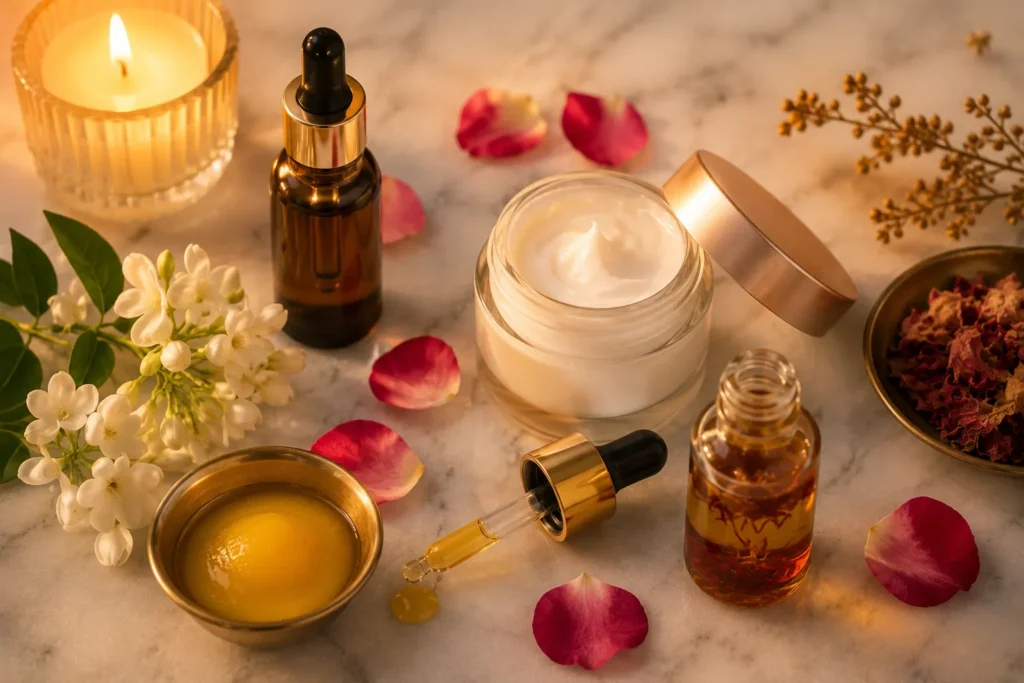

There’s a shift that happens in your skin around your 30s — and if you’ve noticed it, you’re not imagining it. That effortless glow you had at 22 requires a little more intention now. Recovery from a late night takes longer. The fine line that appeared near your eye isn’t going away on its own. Your skin feels drier in places it never used to.
This isn’t your skin failing you. It’s your skin changing — and it deserves a routine that changes with it.
For Indian women specifically, the 30s bring a particular combination of concerns: sun damage that’s been accumulating for years starts showing up as dark spots and uneven tone, stress and hormonal shifts affect skin texture and elasticity, and the natural slowdown in cell turnover means skin takes longer to refresh itself. A night routine — done consistently and correctly — is where most of this repair happens.
Your skin does the vast majority of its renewal work while you sleep. Cell turnover peaks between 11 PM and 4 AM. Collagen synthesis accelerates at night. Blood flow to the skin increases. The ingredients you apply before bed have hours to absorb deeply without competition from sunscreen, makeup, or environmental exposure.
This guide is built specifically for Indian skin in your 30s — the concerns are real, the product recommendations are affordable and available in India, and the routine is designed to be sustainable, not overwhelming.

What Changes in Your Skin After 30
Understanding what’s actually happening in your skin makes it much easier to choose the right products and stick with the routine.
Collagen production slows down. From your mid-20s, collagen production declines by roughly 1% per year. By your early 30s, this begins to show — skin feels slightly less firm, fine lines become more persistent, and pores appear larger because the skin around them has lost some of its structural support.
Cell turnover slows significantly. In your 20s, skin cells renew approximately every 28 days. By your 30s, this cycle extends to 35–45 days. Dead skin cells accumulate on the surface longer, causing dullness, uneven texture, and making dark spots and hyperpigmentation more stubborn.
Melanin production becomes more uneven. Years of sun exposure — commuting, outdoor time, inadequate SPF — start manifesting as dark spots, patchy tan, and uneven tone. Indian skin’s higher baseline melanin makes this more pronounced.
Skin barrier becomes less resilient. The lipid layer that keeps moisture in and irritants out becomes thinner. Skin that was normal in your 20s can feel combination or dry in your 30s. Sensitivity increases.
Hormonal fluctuations intensify. Perimenopause can begin as early as the late 30s, and even before that, oestrogen fluctuations throughout the month significantly affect skin hydration, oiliness, and collagen levels.
The right night routine addresses all of these simultaneously — without requiring an hour before bed or a shelf full of expensive imports.
The Complete Night Skincare Routine for Indian Women Over 30
Step 1 — Double Cleanse (5 minutes)
The most underrated step in any night routine, and the one most Indian women skip. If you’ve worn SPF during the day (which you absolutely should be), a single cleanser is not enough to remove it fully. Sunscreen residue left on skin overnight clogs pores and prevents your night products from absorbing properly.
First cleanse — oil or micellar water: Use a cleansing oil or micellar water to dissolve SPF, makeup, and sebum. Massage gently for 60 seconds and rinse, or wipe away with a cotton pad. Good affordable options: Simple Micellar Cleansing Water (₹299), Garnier Micellar Rose Water (₹249), or Plum Cleansing Balm (₹395).
Second cleanse — gentle foaming or gel cleanser: Follow with a gentle, pH-balanced face wash suited to your skin type. This removes anything the first cleanser left behind and preps skin for absorption. Options: CeraVe Hydrating Cleanser (₹799), Minimalist Amino Acid Face Wash (₹299), La Shield Gentle Cleanser (₹395).
What to avoid: Harsh, foaming cleansers with sulphates that leave skin feeling squeaky clean — that tight feeling means your moisture barrier has been stripped.
Step 2 — Exfoliate (2–3 times a week only, not daily)

After 30, regular exfoliation is non-negotiable — but the kind of exfoliation matters enormously. Physical scrubs with harsh particles (walnut shell, apricot kernels) cause micro-tears in skin and worsen pigmentation over time. Switch to chemical exfoliants.
For most Indian skin types over 30 — AHA (glycolic or lactic acid): AHAs work on the surface, dissolving the bonds between dead skin cells to reveal fresher, brighter skin underneath. They’re particularly effective for dark spots, uneven tone, and dullness — the most common concerns for Indian women in their 30s.
Options:
- Minimalist 8% AHA BHA Toner (₹349) — gentle, well-formulated, excellent for beginners
- Cosrx AHA/BHA Clarifying Treatment Toner (₹799) — slightly stronger, for experienced exfoliant users
- The Derma Co 10% Lactic Acid Serum (₹399) — ideal for dry or sensitive skin as lactic acid is gentler than glycolic
Use exfoliants on alternate nights maximum — never on the same night as retinol. On nights you exfoliate, skip retinol. On nights you use retinol, skip exfoliants.
Step 3 — Toner or Essence (optional but recommended)
A hydrating toner or essence after cleansing prepares skin to absorb subsequent products more effectively — think of it as priming a wall before painting. It also adds the first layer of hydration.
Best options for Indian skin over 30:
- Rose water (pure, no alcohol) — deeply affordable, effective, and works for all skin types. Kama Ayurveda Pure Rose Water (₹295) or Juicy Chemistry Rose Water (₹350) are excellent.
- Cosrx Advanced Snail 96 Mucin Power Essence (₹999) — a cult product that deeply hydrates and improves skin texture over time. Worth every rupee for women in their 30s.
- Minimalist Multi-Peptide Toner (₹449) — peptides support collagen synthesis, making this particularly suited for anti-ageing routines.
Apply by pressing gently into skin with clean fingertips — not wiping with a cotton pad, which wastes product.
Step 4 — Active Serum (the most important step)
This is where the real transformation happens. After 30, your night routine needs at least one targeted active ingredient that addresses your specific concerns. Here are the three most important for Indian skin in this decade:
Option A — Retinol (for anti-ageing, dark spots, and overall skin renewal)
Retinol is the gold standard of anti-ageing skincare — the most extensively studied topical ingredient for stimulating collagen production, accelerating cell turnover, fading pigmentation, and reducing fine lines. For Indian women over 30, it is genuinely the single most impactful ingredient you can add to your routine.
How to start without irritation:
- Begin with the lowest concentration — 0.1% or 0.2%
- Apply only twice a week for the first month
- Use the sandwich method: moisturiser first, retinol on top, moisturiser again on top
- Expect some initial dryness and flaking — this is normal and settles within 4–6 weeks
- Never use retinol on the same night as AHAs or vitamin C
Affordable Indian options:
- Minimalist 0.2% Retinol Serum (₹449) — best starting point for beginners
- The Derma Co 0.1% Retinol Serum (₹549) — ultra-gentle, good for sensitive skin
- Dot & Key Retinol + Peptide Serum (₹595) — retinol combined with peptides for enhanced anti-ageing
Option B — Niacinamide (for pores, oiliness, and dark spots)
If retinol feels too strong to start with, or if your primary concerns are enlarged pores, oiliness, and dark spots rather than fine lines — niacinamide is your starting active. It’s gentle, non-irritating, works on multiple concerns simultaneously, and is suitable for daily use.
Minimalist 10% Niacinamide Serum (₹349) is one of the best-formulated, most affordable options available in India and is a near-perfect choice for this skin type and age group.
Option C — Peptide Serum (for firmness and anti-ageing without irritation)
Peptides are short chains of amino acids that signal skin to produce more collagen. They’re significantly gentler than retinol, making them suitable for very sensitive skin or as a complement to retinol on the nights you’re not using it.
The Ordinary Buffet Multi-Peptide Serum (₹1,190) and Minimalist Multi-Peptide + HA Serum (₹599) are both excellent options available in India.

Step 5 — Eye Cream
The skin around the eyes is the thinnest on the entire face and shows ageing earliest. After 30, a dedicated eye cream used consistently at night makes a visible difference over months — reducing dark circles, fine lines, and under-eye puffiness.
Application technique matters: Use only your ring finger (applies the least pressure) and pat — never rub — the product along the orbital bone. Do not drag the skin.
Options:
- Dot & Key Cooling Eye Cream (₹445) — caffeine for puffiness, niacinamide for dark circles
- Plum Bright Years Cell Renew Eye Cream (₹549) — retinol-adjacent ingredients for fine lines
- Kama Ayurveda Eladi Hydrating Ayurvedic Face Cream (₹1,095) — Ayurvedic herbs for hydration and brightening
If budget is a concern — pure aloe vera gel applied under the eyes overnight is a genuinely effective alternative that costs almost nothing.
Step 6 — Moisturiser (always, even for oily skin)
Night moisturiser for women over 30 serves two purposes: it seals in everything you’ve applied and provides its own active hydration during the long hours of sleep.
After 30, your moisturiser should contain at least one of: hyaluronic acid (draws water into skin), ceramides (repair the skin barrier), or peptides (support collagen). Ideally all three.
For oily or combination skin: A lighter gel-cream formula works better than a heavy cream. Neutrogena Hydro Boost Gel Cream (₹699), Plum Green Tea Renewed Clarity Night Gel (₹549).
For normal to dry skin: A richer cream with ceramides and fatty acids. CeraVe Moisturising Cream (₹899), Minimalist Oat & Ceramide Moisturiser (₹449), or a traditional Indian option — pure cold-pressed almond oil mixed with 2 drops of rosehip oil pressed lightly into the skin.
For very dry or mature skin: A facial oil as the final step seals everything in. Rosehip oil, sea buckthorn oil, or pure bakuchi oil (the Ayurvedic alternative to retinol, available from brands like Juicy Chemistry and Forest Essentials) all work beautifully.
Step 7 — Lip Care (60 seconds, don’t skip this)
Lips have no sebaceous glands — they can’t moisturise themselves. And like the rest of the face, lip skin ages and loses plumpness with time. One minute of lip care before bed makes a cumulative difference.
Apply pure desi ghee, almond oil, or a simple lip balm like Himalaya Lip Butter (₹99) or The Body Shop Vitamin E Lip Care (₹399) before sleeping. That’s all.
Quick 5-Minute Practice ✨ The “5-Minute Night Reset” — every night before bed, set a 5-minute phone timer. In those 5 minutes: double cleanse, apply your active serum, and moisturise. No elaborate routine, no 12 steps. Just these three — done consistently every single night — will transform your skin over 90 days more than an occasional elaborate routine ever could. Consistency beats complexity every single time after 30.
The Ayurvedic Night Skincare Additions
For Indian women who want to blend modern actives with traditional wisdom, these Ayurvedic additions integrate beautifully into a night routine:
Kumkumadi Oil — perhaps the most celebrated Ayurvedic beauty preparation, made from saffron, sandalwood, and over 20 herbs. Applied as the final step — 2–3 drops pressed into skin — it works overnight to brighten, even skin tone, and reduce pigmentation. Forest Essentials and Kama Ayurveda both make excellent versions.
Bakuchi (Psoralea corylifolia) — Ayurveda’s answer to retinol. Contains psoralen, a natural compound with retinol-like cell-renewal properties but significantly gentler. Ideal for women who find retinol too irritating. Available as bakuchi oil or in serums from Juicy Chemistry and Earth Rhythm.
Manjistha — an Ayurvedic herb with powerful blood-purifying and skin-brightening properties. Available as a face pack powder or in night creams from brands like Biotique and Forest Essentials. Particularly effective for reducing pigmentation and uneven tone.
Pure Ghee — under-eye application and on very dry areas. Desi ghee contains vitamins A, D, E and K and has been used as a skin emollient in Indian households for centuries. A tiny amount pressed around the eyes and on dry patches overnight is deeply nourishing.
What to Avoid in Your Night Routine After 30
Using the same products you used at 22. Your skin’s needs have genuinely changed. A simple moisturiser that was sufficient at 22 is not sufficient at 32. This isn’t vanity — it’s maintenance.
Using retinol and AHAs on the same night. Both are powerful exfoliants. Using them together causes significant irritation, redness, and barrier damage. Alternate: exfoliant nights and retinol nights should never overlap.
Applying too many actives at once. More products do not mean better results. Three to four well-chosen, correctly layered products will always outperform eight randomly combined ones. Keep it simple.
Skipping moisturiser because skin feels oily. Oily skin still needs hydration — particularly after actives like retinol and AHAs that can be drying. A lightweight gel moisturiser keeps oily skin balanced without adding greasiness.
Going to bed with wet hair regularly. This sounds unrelated to skincare — but wet hair pressed against your face for 7–8 hours deposits moisture, creates friction, and can contribute to breakouts and irritation along the hairline and cheeks.
A Simple Weekly Night Routine Schedule
The key to a sustainable routine is knowing which products go on which nights — so you’re never guessing:
| Night | Routine |
|---|---|
| Monday | Cleanse → Niacinamide serum → Moisturiser |
| Tuesday | Cleanse → AHA exfoliant → Moisturiser |
| Wednesday | Cleanse → Retinol (sandwich method) → Eye cream |
| Thursday | Cleanse → Niacinamide or peptide serum → Moisturiser |
| Friday | Cleanse → AHA exfoliant → Moisturiser → Kumkumadi oil |
| Saturday | Cleanse → Retinol (sandwich method) → Eye cream |
| Sunday | Cleanse → Hydrating mask or aloe vera → Moisturiser (recovery night) |
This schedule rotates actives intelligently, prevents over-exfoliation, and includes a recovery night for the skin barrier — the most sustainable approach to active skincare after 30.
Frequently Asked Questions
When exactly should Indian women start an anti-ageing night routine?
The best time to start is your late 20s — before visible signs appear — because prevention is significantly easier than correction. But if you’re already in your 30s and starting now, you haven’t missed the window. Skin responds to the right routine at any age. Starting at 32 or 38 will still produce meaningful, visible improvement within 2–3 months.
Is retinol safe for Indian skin tone?
Yes — retinol is safe and effective for all skin tones including darker Indian skin tones. The one important caution for Indian skin specifically is that retinol can cause post-inflammatory hyperpigmentation if introduced too quickly. Always start low (0.1–0.2%), go slow, and use SPF every morning without exception.
Can I use retinol if I have oily, acne-prone skin?
Retinol is actually particularly beneficial for acne-prone skin — it regulates cell turnover, prevents pore clogging, and fades post-acne marks. Start with a very low concentration and apply it on dry skin (wait 20 minutes after cleansing) to reduce the chance of irritation.
How long does it take to see results from a night skincare routine?
For hydration and immediate glow — 1–2 weeks. For reduced dark spots and more even tone — 6–8 weeks. For visible improvement in fine lines and firmness with retinol — 3–6 months of consistent use. Skincare is a long game, but the results are cumulative and lasting when you stay consistent.
I have very sensitive skin — can I still build a night routine with actives?
Absolutely. Start with the gentlest options: lactic acid instead of glycolic acid for exfoliation, bakuchi oil instead of retinol, niacinamide instead of stronger brighteners. Give each new product at least 3–4 weeks before assessing whether to continue or adjust. Sensitive skin can absolutely benefit from actives — it just needs a slower, more cautious introduction.
Should I use a different moisturiser for day and night?
Ideally yes — a day moisturiser should contain or work well under SPF and be lightweight. A night moisturiser can be richer and contain actives like retinol or peptides that you wouldn’t use during the day. However if budget is a constraint, one good ceramide-based moisturiser used morning and night is perfectly adequate.
Do I need an eye cream or can I use my regular moisturiser around the eyes?
A dedicated eye cream is formulated for the delicate, thin skin around the eyes and is generally safer than applying regular face moisturiser there. Many face products contain concentrations of actives too high for the eye area. That said, if budget is a constraint, pure aloe vera gel or a tiny amount of cold-pressed almond oil around the eyes overnight is a safe, effective alternative.
The Bottom Line
Your 30s are not when your skin starts declining — they’re when your skin starts requiring intention. The difference between skin at 40 that looks tired and skin at 40 that looks luminous and healthy comes down almost entirely to what happens during those 7–8 hours of sleep every night, over years.
You don’t need 12 steps. You don’t need expensive imports. You need a consistent routine built around a handful of well-chosen, correctly used products — and the patience to trust the process for at least 90 days before judging the results.
The night is when your skin does its best work. Give it the right tools and get out of the way.
Also read on CGlows:
- [Vitamin C Serum for Indian Skin — Benefits and How to Use It]
- [How to Use Aloe Vera Gel on Face Overnight — Complete Guide]
- [Signs of Hormonal Imbalance in Women — What Your Body Is Telling You]
Disclaimer: This article is for general informational purposes only and is not a substitute for professional dermatological advice. If you have a diagnosed skin condition or significant skin concerns, please consult a qualified dermatologist before beginning a new active skincare routine.
Discover more from CGlows
Subscribe to get the latest posts sent to your email.