
If there is one skincare ingredient that dermatologists, beauty editors, and seasoned skincare enthusiasts unanimously agree on — it’s Vitamin C. It shows up in everything from ₹150 drugstore serums to ₹5,000 luxury vials, and for good reason. Few ingredients have the body of scientific evidence behind them that Vitamin C does.
But here’s what most generic skincare content misses: Indian skin has very specific concerns — hyperpigmentation from sun exposure, uneven skin tone, post-acne dark marks, tan lines, and the dullness that comes from living in high-UV, high-pollution environments year-round. And Vitamin C, when used correctly, addresses almost every single one of them.
This is the guide for Indian skin specifically — what Vitamin C actually does, how to use it without the irritation most people experience, which products are worth buying, and what common mistakes are quietly sabotaging your results.
What Is a Vitamin C Serum and Why Does It Matter for Indian Skin?
Vitamin C (also called L-ascorbic acid in its purest, most potent form) is a water-soluble antioxidant that plays a central role in skin health. Your body cannot produce it on its own — which means your skin depends entirely on what you apply topically and what you eat to maintain healthy Vitamin C levels in skin tissue.
For Indian skin specifically, here’s why it matters more than for most other skin types:
Our skin produces significantly more melanin — the pigment responsible for our natural skin tone. While this gives us natural UV protection that lighter skin types lack, it also means our skin is more prone to post-inflammatory hyperpigmentation (PIH) — the dark marks left behind after a pimple, a cut, or sun damage. Vitamin C directly inhibits the enzyme (tyrosinase) that drives melanin production, making it one of the most targeted treatments for this exact problem.
7 Real Benefits of Vitamin C Serum for Indian Skin
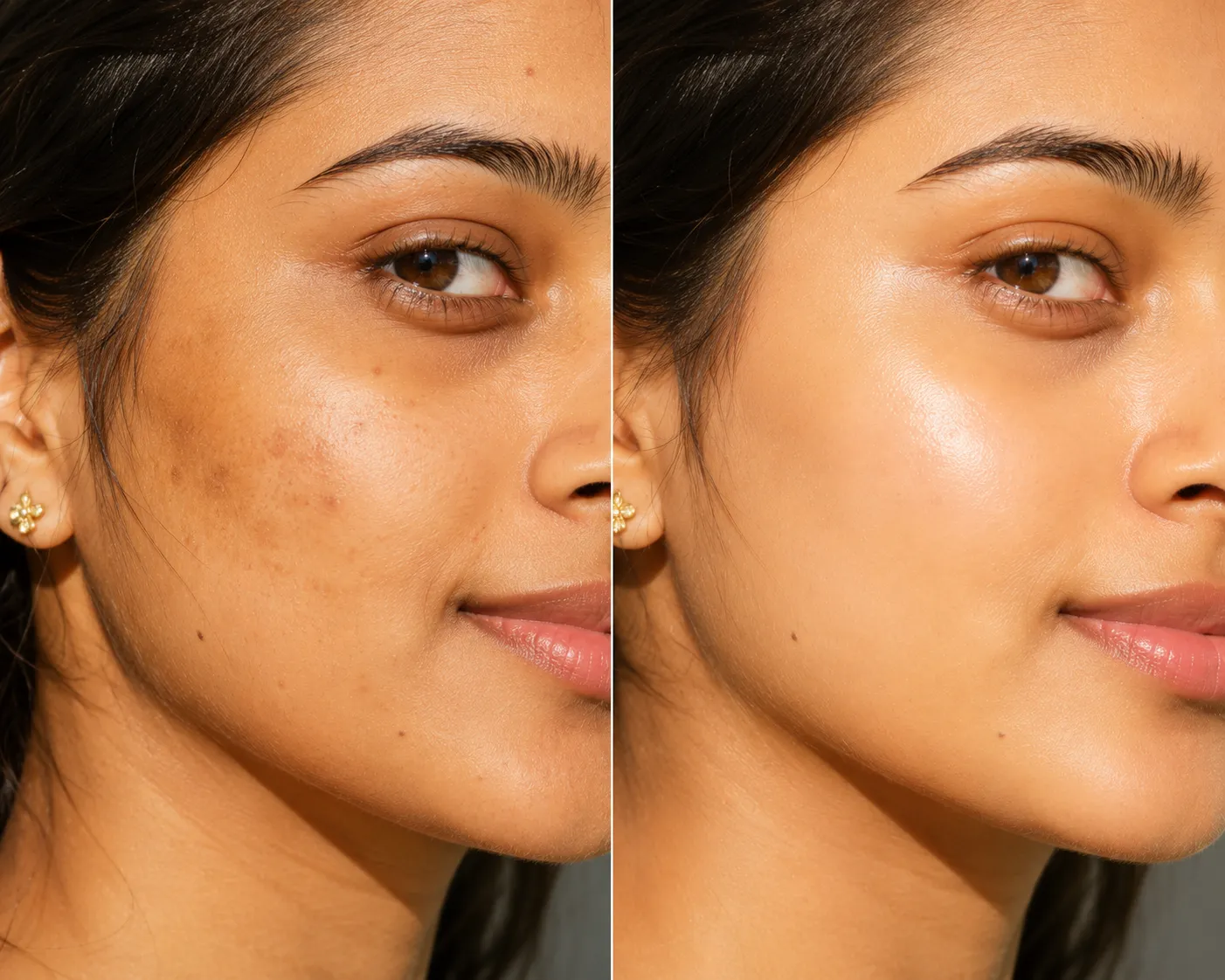
1. Fades Dark Spots and Post-Acne Marks
This is the number one reason Indian women reach for Vitamin C serums. The combination of acne (which is extremely common in India’s humid, polluted climate) and our skin’s tendency toward hyperpigmentation means most of us are walking around with a constellation of dark marks long after the original pimple has healed. Vitamin C inhibits melanin production at the source, gradually lightening these marks with consistent use over 4–8 weeks.
2. Reverses Sun Tan and UV Damage
India has some of the highest UV index levels in the world — and most of us are commuting, working outdoors, or simply going about daily life without adequate sun protection. Vitamin C neutralises free radicals generated by UV exposure before they can cause lasting pigmentation. Used alongside SPF, it forms one of the most powerful anti-tan duos in skincare.
3. Brightens Overall Skin Tone
Beyond dark spots, Vitamin C gives skin an overall luminosity — that “lit from within” glow that no highlighter can fully replicate. It does this by inhibiting excess melanin production across the skin surface, not just in concentrated dark spots, creating a more even, radiant complexion.
4. Boosts Collagen Production
Vitamin C is essential for collagen synthesis — it’s the cofactor that allows collagen-producing cells (fibroblasts) to do their job. More collagen means firmer, plumper skin with fewer fine lines. This makes Vitamin C serum valuable not just for brightening but for long-term anti-ageing, particularly for women in their late 20s and 30s.
5. Strengthens the Skin Barrier
A strong skin barrier means skin that holds moisture better, reacts less to environmental stressors, and recovers faster from irritation. For Indian skin dealing with year-round humidity, pollution, and heat — a reinforced barrier is genuinely protective.
6. Reduces Under-Eye Dark Circles
The under-eye area is especially prone to pigmentation in Indian skin, partly genetic and partly from UV exposure. Vitamin C applied carefully to the under-eye area can lighten this pigmentation over time and the collagen-boosting effect plumps the thin skin, reducing the appearance of hollowness.
7. Enhances SPF Effectiveness
This is the most underappreciated benefit. Studies have shown that Vitamin C applied before sunscreen increases the skin’s overall protection from UV damage beyond what the SPF number alone provides. The antioxidant action neutralises free radicals that sunscreen physically blocks UV from reaching the skin. Together, they’re significantly more effective than either alone.
How to Use Vitamin C Serum on Face — Step by Step

Morning Is the Right Time
Vitamin C is a daytime ingredient. Its antioxidant properties are most useful during the day when your skin is actively being exposed to UV rays and environmental pollution. Applying it at night isn’t harmful, but you’re missing its primary protective benefit.
The correct morning order: Cleanser → Toner (optional) → Vitamin C serum → Moisturiser → SPF
Step-by-Step Application
Step 1 — Cleanse thoroughly. Use a gentle foaming or gel cleanser suited to your skin type. Pat dry.
Step 2 — Apply Vitamin C serum. Take 3–4 drops and warm between your fingertips. Press gently onto your face — don’t rub aggressively. Start at the forehead, move to cheeks, nose, and chin. Allow 60–90 seconds to absorb before layering anything on top.
Step 3 — Apply moisturiser. Lock in the serum with a lightweight, oil-free moisturiser if you have oily skin, or a richer cream if you have dry skin.
Step 4 — Apply SPF. Non-negotiable. Vitamin C and SPF together is your strongest possible defence against tan, pigmentation, and premature ageing. If you skip SPF after Vitamin C, you’re wasting the serum.
Starting Vitamin C — How to Avoid the Irritation Most People Experience
One of the most common complaints about Vitamin C serums is irritation — redness, tingling, and breakouts — especially in the first two weeks. This almost always comes from starting with too high a concentration too quickly.
The right way to introduce Vitamin C:
- Week 1–2: Apply every other day. Use a lower concentration — 5–10% is ideal for beginners.
- Week 3–4: Move to daily application once your skin has adapted.
- After month 1: You can graduate to a higher concentration (15–20%) if you want more intensive results.
Always do a patch test on your inner wrist for 24 hours before applying any new Vitamin C product to your face.
Quick 5-Minute Practice ✨ Every morning after cleansing, apply 3–4 drops of Vitamin C serum to your face and take 60 seconds to press it in gently using your fingertips in upward motions. Follow immediately with SPF. That’s it — two products, two minutes, and you’ve built the most scientifically backed daily defence against tan, dark spots, and premature ageing that skincare has to offer. Do this for 30 days and check the difference in your skin tone.

Can You Mix Vitamin C With Other Ingredients?
This is where most people get confused — and where wrong combinations can cause irritation or cancel out benefits.
✅ Vitamin C + SPF — Best combination in skincare. Always pair these.
✅ Vitamin C + Niacinamide — The old myth that these two cancel each other out has been thoroughly debunked. Modern formulations combine them effectively. Niacinamide reduces pores and controls oil while Vitamin C brightens — excellent combination for Indian skin.
✅ Vitamin C + Hyaluronic Acid — Hydration + brightening. Apply hyaluronic acid first on damp skin, then Vitamin C serum on top.
✅ Vitamin C + Ferulic Acid — Many quality serums already combine these. Ferulic acid stabilises Vitamin C and makes it significantly more effective.
⚠️ Vitamin C + Retinol — Use them at different times. Vitamin C in the morning, retinol at night. Using both together can cause irritation.
⚠️ Vitamin C + AHAs/BHAs — If you use chemical exfoliants like glycolic acid or salicylic acid, don’t layer them with Vitamin C in the same routine. Alternate days, or use exfoliants at night and Vitamin C in the morning.
❌ Vitamin C + Benzoyl Peroxide — These actively cancel each other out. Never use them together.
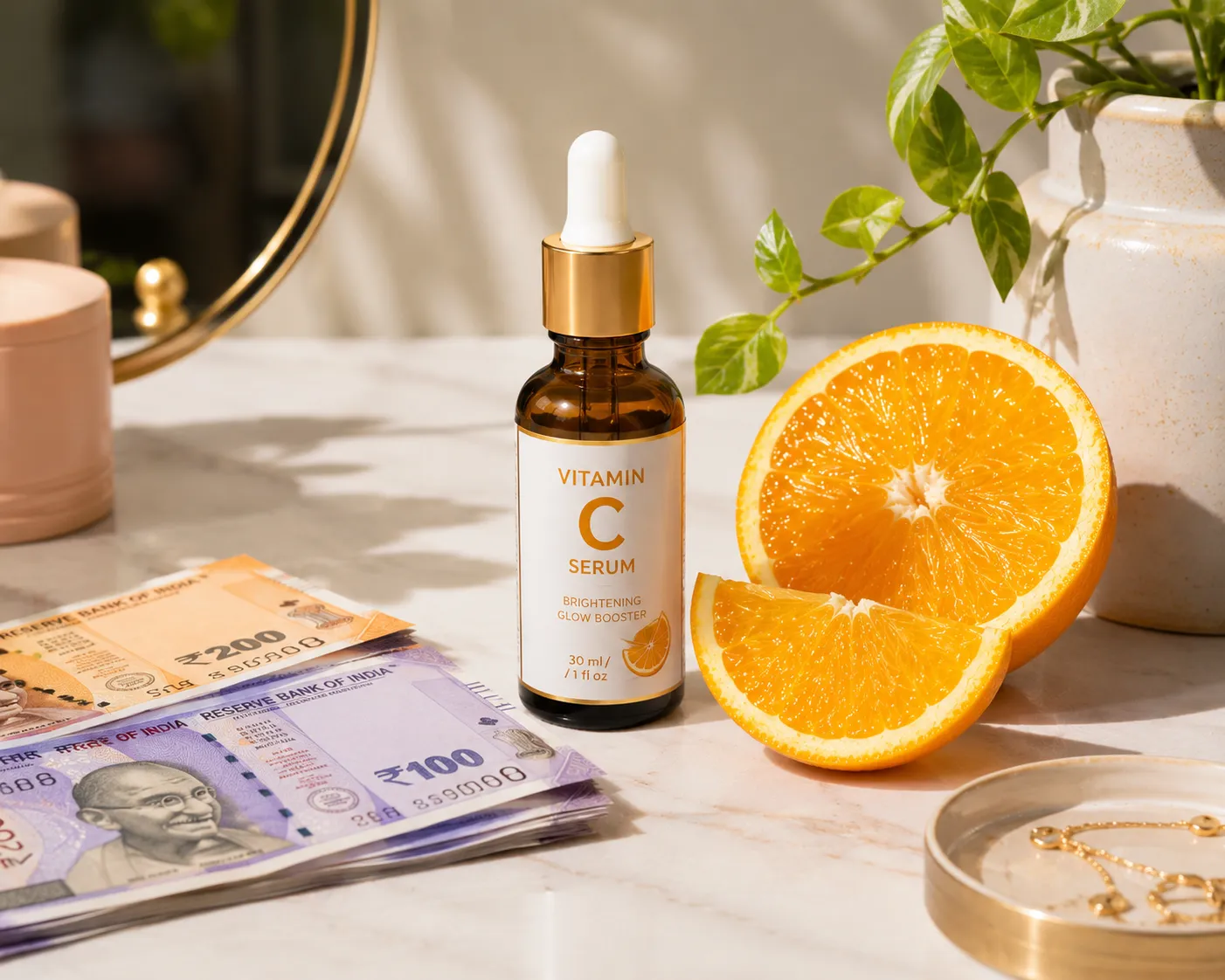
Best Vitamin C Serums for Indian Skin — Tried, Tested, and Affordable
| Product | Concentration | Price | Best For |
|---|---|---|---|
| Minimalist 10% Vitamin C + E + Ferulic Acid | 10% | ₹349 | Beginners, sensitive skin |
| Dot & Key Glow Revealing Vitamin C Serum | 15% | ₹445 | Brightening + glow |
| Plum 15% Vitamin C Face Serum | 15% | ₹399 | Dark spots + oily skin |
| Re’equil Vitamin C & E Face Serum | 20% | ₹499 | Intense pigmentation |
| Mamaearth Skin Illuminate Vitamin C Serum | 10% | ₹269 | Budget option, beginners |
| WOW Skin Science Vitamin C Serum | 20% | ₹449 | Anti-ageing + brightening |
CGlows pick for first-time users: Start with Minimalist 10% Vitamin C + E + Ferulic Acid — it’s the most stable, well-formulated, and beginner-friendly option available in India at ₹349. The ferulic acid combination makes it significantly more effective than a plain Vitamin C serum at the same concentration.
Why Your Vitamin C Serum Might Not Be Working
If you’ve been using a Vitamin C serum for weeks without results, one of these is likely the reason:
The serum has oxidised. Vitamin C is notoriously unstable — it degrades when exposed to light, air, and heat. An oxidised serum turns yellow or orange (a fresh Vitamin C serum is colourless or very pale yellow). Oxidised Vitamin C not only stops working but can actually cause more pigmentation. Store your serum in a dark, cool place and use it within 3 months of opening.
You’re skipping SPF. Without SPF, UV rays continue stimulating melanin production faster than Vitamin C can inhibit it. You’re essentially running a race against your own skin. SPF is not optional when using Vitamin C.
The concentration is too low. Formulations below 5% have minimal effect on pigmentation. If your product lists Vitamin C vaguely without specifying percentage, assume it’s likely decorative rather than functional.
You’re not being consistent. Vitamin C needs daily use for a minimum of 4–6 weeks to produce visible results on hyperpigmentation. Occasional use produces no meaningful change.
You’re using the wrong form. L-ascorbic acid is the gold standard — most potent but also most unstable and irritating. For sensitive skin, look for more stable derivatives like sodium ascorbyl phosphate or ascorbyl glucoside — they’re gentler and still effective, just slightly slower acting.
Frequently Asked Questions
At what age should Indian women start using Vitamin C serum?
There’s no strict age limit — Vitamin C is beneficial from your early 20s onwards. In your 20s, use it primarily for sun protection and tan prevention. In your 30s, the collagen-boosting and anti-ageing benefits become increasingly relevant. The earlier you start a consistent Vitamin C routine, the less correction you’ll need later.
Can I use Vitamin C serum if I have acne-prone skin?
Yes — in fact, Vitamin C is particularly helpful for acne-prone Indian skin because it fades post-acne dark marks while providing antioxidant protection. Choose a lightweight, water-based serum (like Minimalist or Plum) rather than oil-based formulations. If your skin is very reactive, start with a lower concentration and alternate-day application.
How long does Vitamin C serum take to show results on Indian skin?
For brightening and overall glow — 2–3 weeks of daily use. For fading specific dark spots and post-acne marks — 6–8 weeks minimum. For significant improvement in deep hyperpigmentation or melasma — 3–6 months, often in combination with other treatments. Consistency is everything.
Should I apply Vitamin C serum before or after moisturiser?
Always before moisturiser. The correct order is cleanser → toner (optional) → Vitamin C serum → moisturiser → SPF. Applying Vitamin C serum after moisturiser creates a barrier that prevents proper absorption into the skin.
Can I use Vitamin C serum every day?
Yes — daily use is not only safe but recommended for best results. Once your skin has adapted (usually after 2–3 weeks), consistent daily morning application is the most effective usage pattern.
Is natural Vitamin C from lemon better than a serum?
No — and this is important. While lemon juice does contain Vitamin C, it’s far too acidic and unstable to be used on skin directly. The concentration is unreliable, it causes photosensitivity, and it can cause chemical burns or severe irritation on sensitive skin. A well-formulated serum with stabilised L-ascorbic acid or its derivatives is always safer and more effective.
What happens if I stop using Vitamin C serum?
The brightening and antioxidant benefits are maintained only with continued use. If you stop, your skin doesn’t deteriorate suddenly — but you lose the ongoing protection against UV-induced pigmentation and the active lightening of dark spots slows down significantly.
The Bottom Line
For Indian skin dealing with hyperpigmentation, uneven tone, sun tan, post-acne marks, and the dullness that comes from living in high-UV environments — Vitamin C serum isn’t a luxury. It’s one of the most practical, evidence-backed additions to a daily skincare routine.
Start with a beginner-friendly 10% formulation like Minimalist, apply it every morning before SPF, be consistent for at least 6 weeks, and store it away from light and heat. That’s genuinely all it takes to see meaningful results on Indian skin.
Your skin tone is beautiful. Vitamin C just helps it look its best — every single day.
Also read on CGlows:
- [How to Remove Tan from Face at Home — 10 Proven Remedies]
- [How to Use Aloe Vera Gel on Face Overnight — Complete Guide]
- [Night Skincare Routine for Indian Women Over 30]
Disclaimer: This article is for general informational purposes only and is not a substitute for professional dermatological advice. If you have a diagnosed skin condition, consult a dermatologist before introducing new active ingredients.
Discover more from CGlows
Subscribe to get the latest posts sent to your email.